MATERIALS

Glass and Specialty

World's Most Productive Companies

Commodity Cycles and Capital Discipline

Integrated metals and mining companies combine upstream extraction with downstream processing across multiple metals and geographies. These are among the most capital-intensive operations in the Materials industry, with investment cycles spanning decades from exploration through development to production. Productivity is tightly linked to commodity prices, asset utilization rates, and the efficiency of capital project execution.

The 2020 demand collapse was followed by one of the sharpest recoveries in industrial history. Metals prices surged in 2021–2022 as post-pandemic restocking, infrastructure spending, and supply constraints converged. Prices normalized through 2023–2024 but remained above pre-pandemic levels for most metals. These companies face significant safety and environmental obligations, workforce challenges in remote operating locations, and increasing pressure from investors and regulators on decarbonization.

Geographic diversification creates both opportunity and complexity. Glencore operates across five continents with diversified commodity exposure; Rio Tinto concentrates on iron ore in Australia and aluminum in Canada; Alcoa spans bauxite, alumina, and smelting globally; while Cleveland-Cliffs focuses on integrated steelmaking in North America. These different portfolio and geographic strategies produced dramatically different productivity trajectories through the commodity cycle, illustrating how capital allocation and portfolio choices matter as much as operational efficiency in determining productivity outcomes for integrated metals companies.

Materials Integrated Metals Mining

Top 100 World's Most Productive Companies - Glass and Specialty

Alcoa

Productivity Snapshot

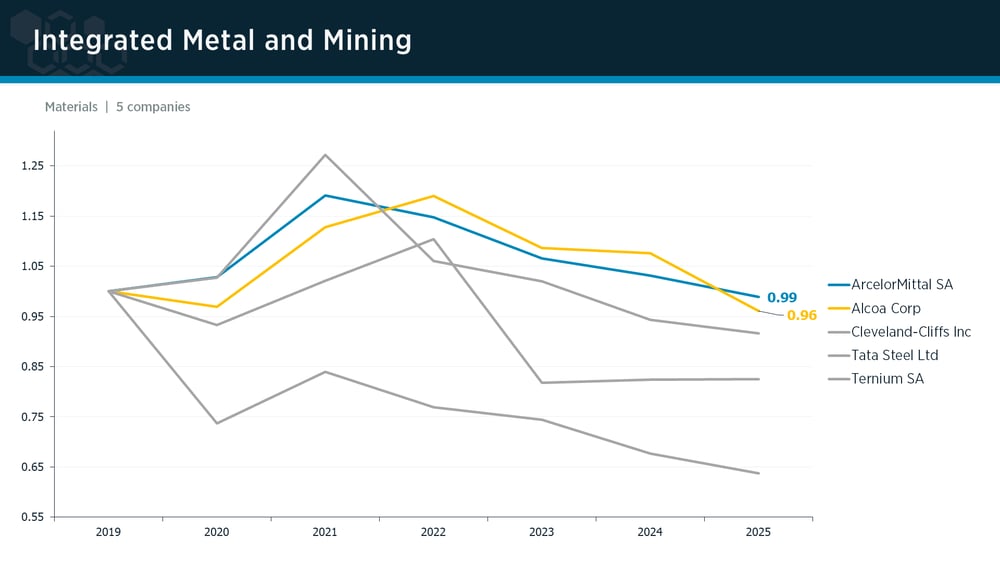
The peer group showed wide dispersion, reflecting the diversity of commodity exposure, geographic mix, and operating model maturity. A strong 2024 recovery, driven by improving metals prices and operational adjustments, brought seven of eight companies back to positive year-over-year growth.

    • Productivity declined 3.6% on average over the last six years, with wide dispersion: Alcoa at +16.2% versus Cleveland-Cliffs at −29.2%. This 45-percentage-point spread reflects the fundamental differences in commodity exposure, cost position, and operating model discipline across the peer group.
    • Four of eight companies with valid data are above their 2019 baseline.
    • In 2024, productivity grew an average of 4.6% across these companies, with seven of eight recording positive year-over-year improvements.
    • Alcoa earned its position within the LNS 2025 World’s Most Productive Companies and Pathfinder status by growing productivity 16.2% while peers averaged a 3.6% decline. Alcoa’s performance is driven by the Alcoa Business System (ABS), a company-wide operating model rooted in lean principles and continuous improvement. ABS governs operations across bauxite mining, alumina refining, and aluminum smelting, providing a unified framework for safety, cost, and quality performance across three distinct industrial processes. Alcoa’s disciplined portfolio management (divesting high-cost smelters and investing in competitive, low-cost capacity positions) reinforced the operational gains and demonstrated how strategic capital allocation and operational discipline can compound productivity in a commodity environment.
WMPC_Materials
Materials-2