MATERIALS

Cement, Aggregates, and Concrete

World's Most Productive Companies

Building Materials in Transition: Regional Cycles Split, Decarbonization Reshapes Operations

Major cement, aggregate, and concrete producers extract, process, and deliver base materials for infrastructure and building projects. They operate energy- and capital-intensive assets under tightening carbon rules; their cost positions depend on the fuel mix, EU ETS (Emission Trading System) and/or CBAM (Carbon Border Adjustment Mechanism) exposure, and permits. Revenues are closely tied to regional infrastructure budgets, housing starts, and non-residential construction. Construction aggregates, including crushed stone, sand, and gravel, are bulky, low-value-per-ton commodities with highly localised markets.
 
Since 2018, demand trends have been region-specific, with post-pandemic rebounds and stimulus in parts of the U.S. contrasting with a cyclical downturn in China and a softer 2024 in Europe. Near-term order books hinge on U.S. public works outlays, Europe’s construction cycle, China’s property correction, and adoption of low-carbon products.
 
In 2024, producers reported mixed volumes and productivity pressure. Some regions faced targeted bottlenecks in SCMs (Supplementary Cementitious Materials) and logistics, while others saw slack. Europe softened; U.S. markets remained price‑disciplined despite lower shipments. Across Holcim, Heidelberg Materials, and Cemex, assets built for steady output are being rebalanced to accommodate fuel switching, a lower clinker factor, and maintenance, while executing decarbonization capital expenditures (capex) such as calcined-clay lines, waste-fuel systems, and CCUS (Carbon Capture, Utilisation, and Storage) pilots.
 
Some markets are still experiencing growth; most notably, India is witnessing multi-year growth, characterised by both rising production and per-capita use.
 
Materials Cement

Top 100 World's Most Productive Companies - Cement, Aggregates and Concrete


Productivity Snapshot

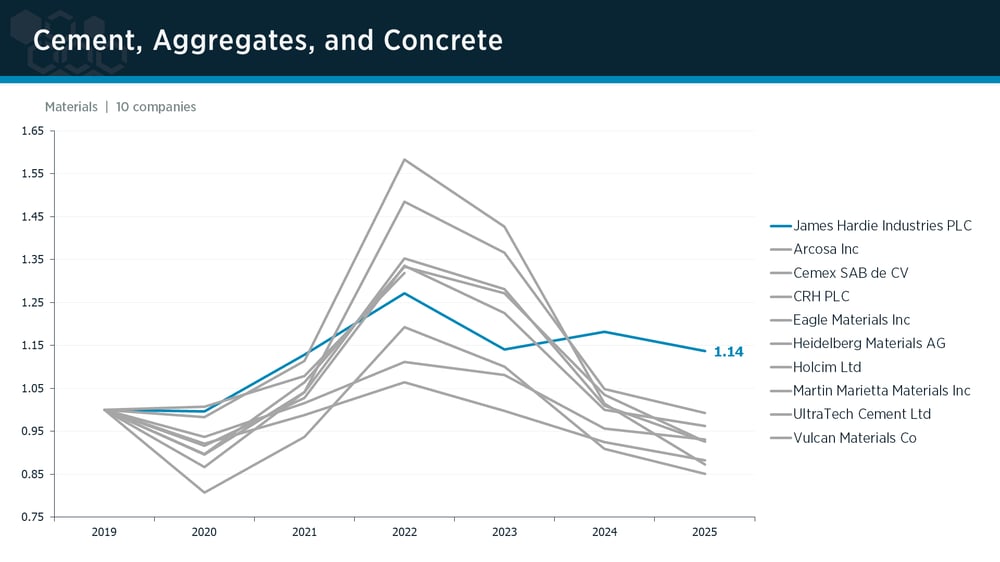
Cement, aggregates, and concrete have performed better than the overall materials industry. However, falling demand makes it harder to improve productivity due to the underutilization of manufacturing assets.
 
Most major manufacturers experienced an increase in productivity from 2023 to 2024, and as a result, their productivity levels are now higher than they were in 2019 (pre-COVID).
 
  • Productivity in the sector grew overall by 5.9% (or 1.2% compound annual growth rate, CAGR) since 2019. This peer group outperformed the average for the materials industry.

  • All companies, except UltraTech Cement, experienced positive productivity growth in 2024. Similarly, all companies, except James Hardie, had productivity growth in 2023.

  • 2024 Productivity increased by an average of 3.6% across these companies.

  • James Hardie Industries PLC, a world-leading manufacturer of high-performance fiber cement building solutions, earned its position within the LNS 2025 World’s Most Productive Companies by growing productivity 13.3% since 2019, 2.25 times more than the average of its peers. James Hardie achieved this by implementing HMOS (Hardie Manufacturing Operating System), integrating sustainability, safety, and continuous improvement into JH’s manufacturing processes.
WMPC_Materials
Materials-2