LIFE SCIENCES
Medical Devices
World's Most Productive Companies

MedTech Leaders: Recovery, Regulation, and Shifting Demand
The listed firms operate across the global medical technology value chain, with portfolios that span implantables, durable medical equipment, active implantable and non-implantable devices, diagnostics, and connected software. They sell primarily to hospitals, ambulatory surgery centers, and clinics, so procedure volumes, payer mix, and hospital capital budgets are foundational demand drivers. All face the same structural challenges: aging and chronic disease, a shift in site of care to outpatient and home, digitization with cybersecurity obligations, post-pandemic procedure recovery, supply-chain resiliency, EU MDR/IVDR compliance, pricing pressure from China, and, in some niches, policy shocks such as U.S. OTC hearing aids and GLP-1-driven demand uncertainty.
The period from 2019 to 2021 brought COVID-driven demand shocks, including procedure deferrals, hospital financial strain, and equipment reallocation. The rebound since 2022 has been driven by catch-up in elective volumes, particularly in orthopedics and cardiology, and by stabilization of hospital capital expenditures, albeit with persistent labor constraints and margin pressure. Measured broadly as output per labor or per operating dollar, productivity tailwinds were multi-factor. Productivity rose as procedures recovered, ASC growth boosted throughput, chip supply normalized, and companies digitized service and sales. Regulatory and procurement pressures catalyzed SKU rationalization and cost takeout, while new channels, such as OTC hearing aids, expanded efficient reach. Net, more revenue per employee and per factory hour.
2024 featured procedure recovery amid hospital budget constraints, supply-chain normalization, ongoing EU MDR/IVDR work, China's VBP pricing, EU IPI escalation, OTC hearing-aid acceleration, and GLP-1 momentum influencing sleep-apnea narratives. Cybersecurity compliance and AI investments shaped roadmaps across imaging, devices, and services. Despite tailwinds, several firm-level factors pressured productivity metrics in 2024. Labor-limited hospitals, destocking after supply shocks, heavy MDR/IVDR and cybersecurity workloads, China's VBP pricing, and European procurement frictions, along with category narratives such as GLP-1s in sleep and OTC disruption in hearing, collectively diluted output per worker or dollar for some medtechs in 2024.

Top 100 World's Most Productive Companies - Medical Devices
Productivity Snapshot
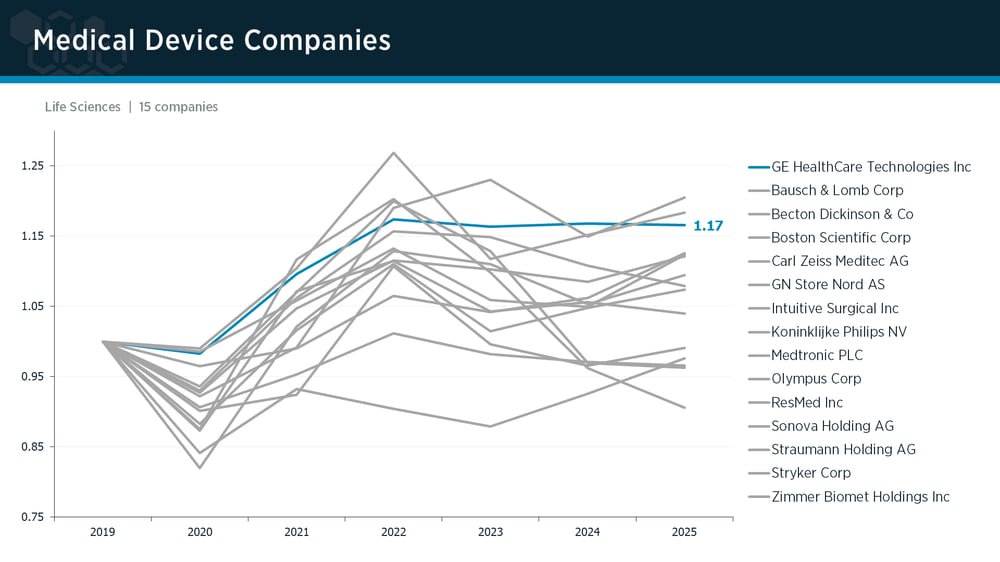
The Medical Device peer group generally followed the pattern of the overall IPI, characterized by a productivity bump from 2020 through 2022, followed by a decline in productivity in 2023 and 2024.
- Productivity for the sector improved by 10.0% over the last six years. This Peer Group performed slightly above the average for manufacturers represented in the IPI.
- Ten of the twelve companies in this peer group had negative productivity growth in 2024.
- 2024 Productivity declined by 4.6% compared to 2023 overall for the group.
- GE Healthcare earned distinction as an LNS Research 2025 World's Most Productive Company. GE Healthcare distinguished itself from the peer group by improving productivity by nearly 2.6 times the peer group average. GE Healthcare achieved this through a lean culture, pricing discipline, mix and service attachment, and supply-chain simplification, steadily lifting productivity and margins, and accelerating post-spin. The throughline is a lean culture, combined with commercial pricing and mix, reinforced by R&D that sustains pricing power. Relative to its peers, GE HealthCare’s scaled lean execution, pricing power, and high-attachment services produced faster post-spin margin gains and a clearer glide path to high teens/20-percent EBIT.