MATERIALS

Glass and Specialty

World's Most Productive Companies

From Float to Fiber: The Precision Manufacturing DNA of Global Glass Leaders

Glass and specialty materials companies operate continuous furnace processes where energy intensity, emissions management, and yield optimization are central to competitiveness. Float glass lines, fiber draw towers, and specialty coating systems run around the clock; furnace shutdowns and restarts are extremely expensive and can take months, creating high operating leverage and making capacity utilization a critical productivity variable.

Production involves complex materials science, specialized equipment with long replacement cycles, and diverse end markets spanning automotive, construction, electronics, and life sciences. Intellectual property and customer qualifications create meaningful barriers to entry: automotive and electronics customers require extensive certification processes that can take years, creating switching costs that protect qualified suppliers. Cullet recycling reduces energy consumption and emissions but faces contamination and color variation constraints that limit recycled content ratios.

The peer group spans distinct operating models, from Vitro and Apogee in architectural glass and containers, to Corning in display, fiber optics, and specialty substrates, to Nippon Sheet Glass in automotive and architectural applications. This diversity of end markets provided natural hedging through the pandemic cycle: construction-exposed companies benefited from the 2021 building boom, while electronics and automotive glass producers tracked different demand patterns. The common thread is materials science depth and process control discipline, competencies that create both productivity advantages and barriers to competitive entry.

Materials Glass

Top 100 World's Most Productive Companies - Glass and Specialty

APOG_BIG-a2351e98
Vitro Architectural Glass

Productivity Snapshot

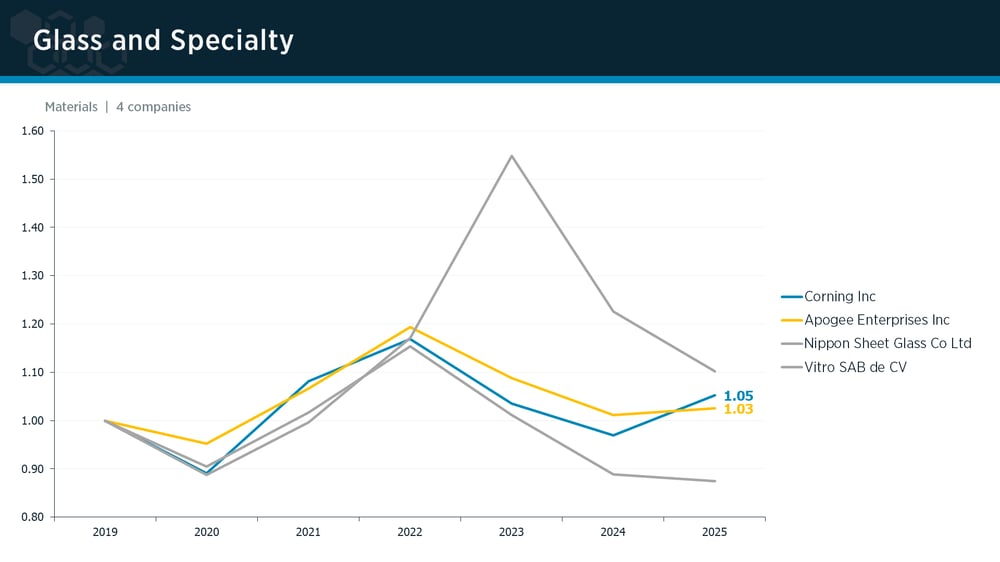
Glass and specialty materials companies posted strong productivity gains, with all companies above their 2019 baseline. The peer group benefited from a combination of construction recovery, growth in automotive glass content, and operational discipline.

    • Productivity grew 14.0% (2.7% CAGR) over the last six years, the third-strongest performance among Materials peer groups.
    • All four companies maintained productivity above 2019 levels, with three of four posting positive year-over-year growth in 2024.
    • In 2024, productivity grew an average of 1.7% across these companies.
    • Vitro earned its position within the LNS 2025 World’s Most Productive Companies by growing productivity 149% more than the average of its peers over the last six years. Vitro’s performance is driven by the Vitro Excellence Model (VOPEX), a company-wide framework integrating lean manufacturing, energy management, and quality systems across its glass operations in Mexico, the U.S., and Latin America. Vitro’s geographic footprint provides cost structure advantages in flat glass and containers, while the VOPEX framework ensures these advantages translate into consistent operational performance.
Apogee Enterprises also earned a position on the 2025 WMPC list by growing productivity 15.3% over the last six years through the Apogee Management System (AMS). AMS unified previously independent business units under a single operating model, embedding continuous improvement talent directly into the business and prioritizing results-first execution and servant leadership. The “One Apogee” transformation restructured the company around shared capabilities (procurement, engineering, talent development) while maintaining end-market specialization in architectural glass and framing systems. 
WMPC_Materials
Materials-2