LIFE SCIENCES
Diversified
World's Most Productive Companies
Multi-Segment Healthcare: Portfolio Discipline Amid MDR and Pricing Pressure
These diversified healthcare leaders share four structural traits. Multi‑segment portfolios spanning medical devices, diagnostics, bioprocess tools, pharmaceuticals, or consumer health, and distribution or services, scaled quality and lean operations, strong regulatory and access capabilities, disciplined capital rotation into higher‑growth adjacencies, data‑enabled commercial and service models, and growing software and AI layers across devices, diagnostics, and life‑science tools.
Six forces dominated 2019–2024 for these companies. Procedure shocks from COVID‑19 suppressed elective procedures across orthopedics, cardiac, and general surgery in 2020–2021, with uneven rebounds by specialty and geography. Supply‑chain and inflation volatility caused companies to re-map suppliers and add inventory buffers. The EU MDR/IVDR transition demands, and the FDA sustained a high pace of device approvals. Tools and bioprocessing experienced an innovation Supercycle. Tighter U.S. pricing policies and shifts in cost of capital are driving resilience investments, digital operations, and portfolio focus. Productivity rose for these companies through lean automation, electronic records, and network optimization; a shift toward recurring consumables; connected services and AI-enabled maintenance; resilient sourcing and near-shoring; stronger MDR-ready design and cybersecurity; and disciplined portfolio rotation into high-return platforms.
2024 combined strong innovation output with ongoing EU MDR transition work, advancing U.S. pricing policies, resilient bioprocessing and diagnostics demand through selective capital spending, continued procedure normalization, and operational benefits from easing supply constraints and digital quality improvements. 2024 productivity dipped due to lagging elective procedures and capital orders, as well as the consumption of engineering time by MDR/IVDR and cybersecurity work. Additionally, U.S. pricing policies tightened budgets, and platform transitions or supplier validations slowed production lines.

Top 100 World's Most Productive Companies - Life Sciences Diversified
Productivity Snapshot
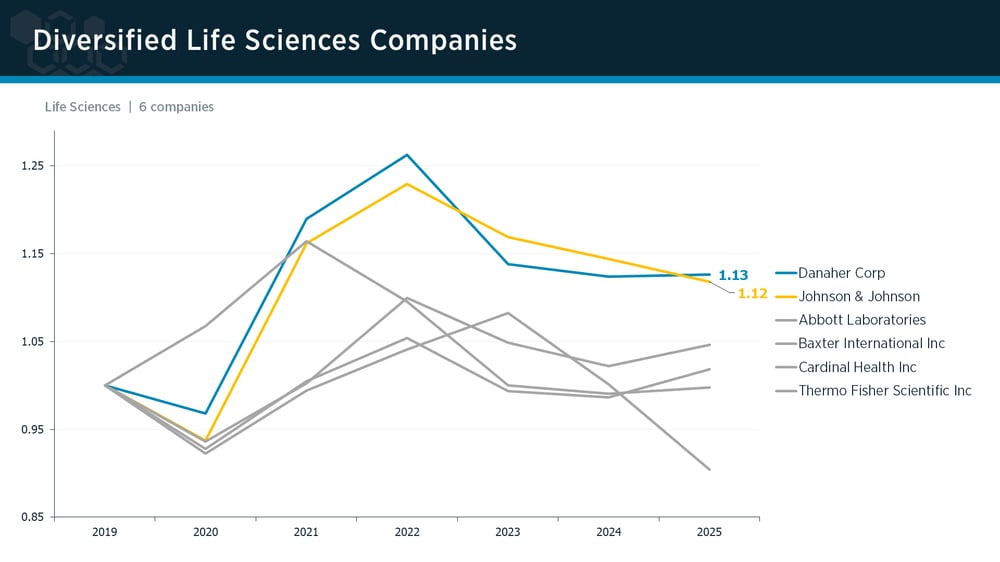
The Diversified peer group generally followed the pattern of the overall IPI, characterized by a bump in productivity from 2020 through 2022, regressing to declining productivity in 2023 and 2024.
- Productivity for the sector improved by 9.4% over the last six years. This Peer Group performed slightly above the average for manufacturers represented in the IPI.
- All seven companies in this peer group had negative productivity growth in 2024.
- 2024 Productivity declined by 4.7% compared to 2023 overall for the group.
- Two companies in this peer group earned a distinction as an LNS Research 2025 World's Most Productive Company. Johnson & Johnson and Danaher.
- Johnson & Johnson distinguished itself from the peer group by improving productivity by over 2.4 times the peer group average. J&J achieved this through concentrating on Innovative Medicine and MedTech, adding scale cardiovascular platforms, separating its Consumer Health division as Kenvue, and reallocating resources post-Kenvue to higher-return franchises.
- Danaher achieved nearly twice the productivity of the peer group average over the six-year period through the disciplined implementation of the Danaher Business System (DBS), a portfolio focus, and a high mix of recurring revenue. Danaher’s six-year productivity edge stems from the DBS operating model applied to a deliberately refocused, high-recurrence portfolio, with the Diagnostics and Biotech platforms scaled through M&A and divestitures that improved the mix, innovation cadence, and operating leverage compared to peers.