
Biopharma
World’s Most Productive Companies
Biopharma: Pipelines, Productivity, and Disciplined Capital
Across large biopharma, a few common threads stand out: a tilt toward specialty therapies and biologics, a push to raise R&D productivity, deepening use of digital and AI in plants and supply chains, and disciplined capital deployment through mergers, acquisitions, and partnerships. The operating model is leaner, more selectively outsourced, and more data-driven from discovery through commercial.
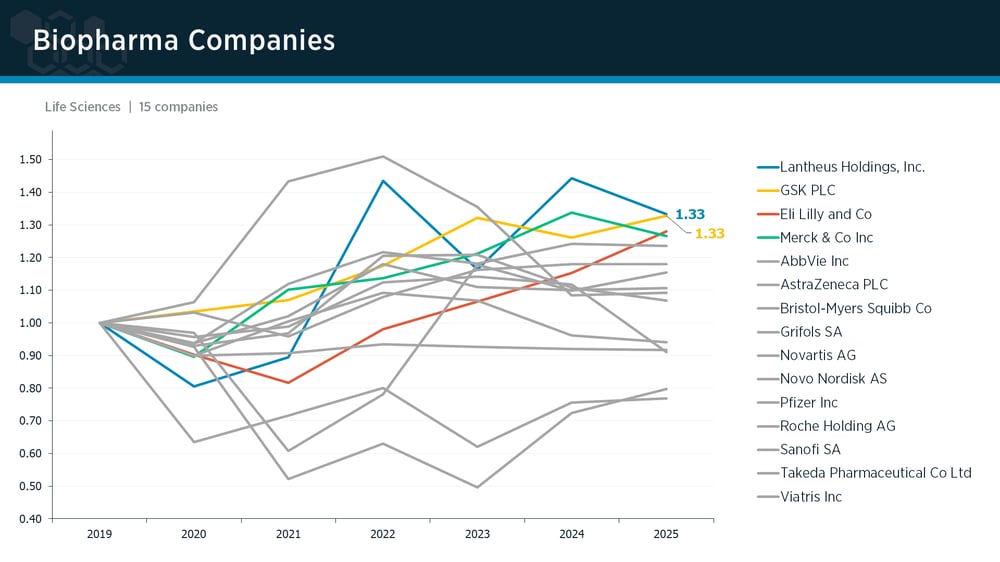
Biopharma is a wide, dispersed peer group, and 2025 widened the spread further. The companies that paired strong pipelines and launch execution with manufacturing readiness for complex biologics and sterile injectables moved productivity up, while those carrying patent-cliff exposure or post-pandemic demand normalization fell back. Plants leaned on AI-enabled process control, advanced analytics, and capacity realignment to stabilize yields and build resilience.
Among the World’s Most Productive Companies, Eli Lilly, Merck, GSK, and Lantheus stood apart. Eli Lilly rose on the strength of its incretin franchise, while Merck has grown productivity well ahead of the peer group over the period by reallocating capital toward high-return assets and streamlining its portfolio.
Biopharma World's Most Productive Companies



Productivity Snapshot
- Biopharma ranks third of eight Life Sciences peer groups for industrial productivity in 2025, about 9% above its 2019 baseline.
- The group is wide and dispersed: 8 of 15 companies grew productivity in 2025 and 7 declined, one of the widest spreads in Life Sciences.
- Four Biopharma companies earned a place among the LNS Research 2026 World’s Most Productive Companies: Eli Lilly, Merck, GSK, and Lantheus.
- Eli Lilly grew about 11% on the year, while Merck has expanded productivity well ahead of its peers over the period by reallocating capital toward high-return assets and streamlining its portfolio.
- At the other end, patent-cliff exposure and post-pandemic demand normalization weighed on several of the group’s largest names, widening the spread.
Interested in learning more about how you stack up, where to improve, and the impact on margin, cash, inventory, and assets?