HIGH-TECH

Semiconductors

World's Most Productive Companies

Chipmakers in Transition: AI Demand vs. Cyclical Drag

Companies in this peer group operate in capital-intensive, cyclical manufacturing systems where scale, yield learning, and mix discipline drive returns. Most are semiconductor makers or foundries serving data center and AI, automotive, industrial, and consumer end markets, so demand and pricing tend to track compute cycles, inventory corrections, and capacity additions.
 
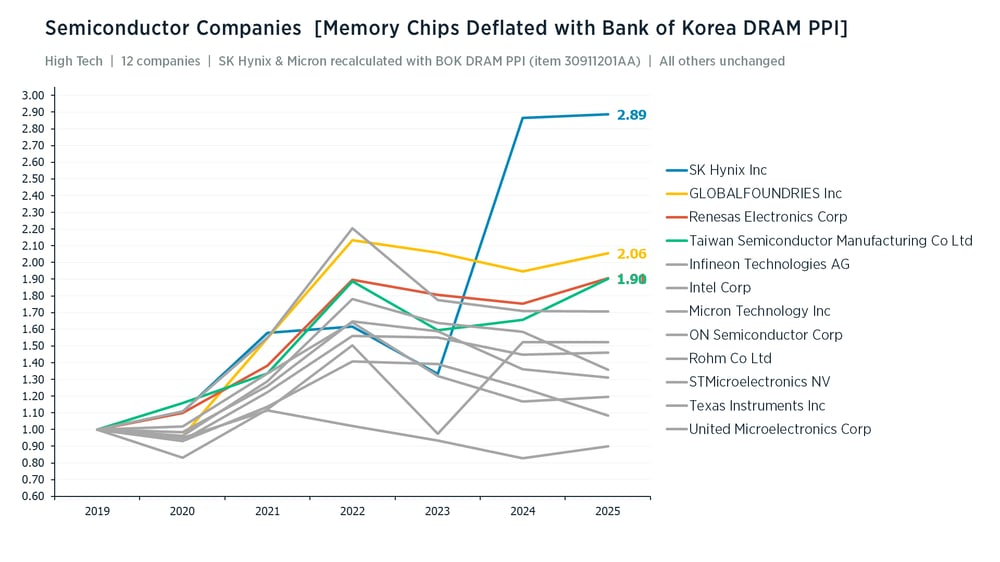
From 2019 to 2021, the pandemic's combined dislocations with a surge in demand and a global chip shortage were particularly painful in the automotive sector. That period reset pricing, allocation, and long-term agreements for capacity assurance. Between 2022 and 2023, conditions shifted to an inventory correction and higher rates. From late 2023 into 2025, AI training and inference ignited a memory-led upcycle and accelerated advanced packaging builds. WSTS and SEMI reported a strong 2024 recovery, along with multi-year equipment and capacity ramps, particularly in leading-edge logic and HBM. SK Hynix is the clear winner of this pivot in 2024, with revenue exceeding that of the prior year by more than double.
 
The peer group's productivity declined in 2024 due to several factors. Where end-markets softened, fabs operated at below-optimal loads, which depressed OEE and increased fixed-cost absorption per unit. Several European analog and power suppliers acknowledged weaker automotive and industrial orders, as well as lowered guidance, a classic setup for lower measured productivity until demand normalizes. Even in hot segments, transitions dilute productivity, as happened in 2023. HBM and new nodes require new tooling, complex requalification, and advanced packaging, which raise start-up and period costs before yields and throughputs stabilize. The April 2024 Taiwan earthquake led to brief evacuations, tool checks, and some wafer scrap across leading fabs, temporarily reducing effective output.
 
High-tech Semiconductors

Top 100 World's Most Productive Companies - Semiconductors

GlobalFoundries
TSMC

Productivity Snapshot

The Semiconductor Peer Group has faced macroeconomic swings over the past six years. Post-pandemic demand drove capacity expansion, leading to acute chip shortages that significantly impacted the automotive industry in 2021 and 2022. The AI hype cycle, which began in late 2022 and gained momentum in 2023, led to a retooling that temporarily depressed productivity. Some are expected to recover in 2024, with a few returning to positive year-over-year productivity results.
 
  • Productivity in the sector increased by a substantial 46.3% over the last six years. This Peer Group performed significantly better than the overall average for manufacturers represented in the IPI.

  • Three of the twelve companies of this peer group had positive productivity growth in 2024.

  • 2024 Productivity fell by an average of 2.4% across these companies.

  • Two of the twelve companies in this peer group are recognized as LNS Research's 2025 World's Most Productive Companies. Global Foundries distinguished itself by improving productivity three times the average of its peer group over the six years through efficient fab utilization, differentiated single-sourced technologies, AI/ML-driven process optimization, strategic capital investments under the CHIPS Act, and disciplined capacity management supported by long-term contracts. Taiwan Semiconductor Manufacturing Company (TSMC), the world's largest semiconductor manufacturer, exceeded the peer group average productivity improvement by a factor of more than two through a combination of advanced process leadership, intelligent manufacturing transformation, global capacity optimization, and deep customer collaboration. The company’s sustained improvement in output per employee and per wafer equipment investment is a direct result of a long-term strategy focused on technology innovation, digital excellence, and manufacturing integration.

  • It is worth noting two distinguishing factors here. Both Global Foundries and TSMC are semiconductor foundries, a term in the semiconductor industry referring to a contract manufacturer. The similarities of their performance with the EMS peer group above might lead to some conclusions about the future of profitable manufacturing. The second distinguishing factor is the rise of AI Chips. While not a WMPC, SK Hynix experienced a significant increase in revenue in 2024, driven mainly by AI chip demand that the company was well-positioned to capitalize on. This drove down their cost per unit. It remains to be seen whether SKH can capitalize on this momentum or if it is just a blip.
WMPC_High-tech
High-tech