HIGH-TECH
Imaging
World's Most Productive Companies
Optical Systems: Transformation, Compliance, and Global Cycles
Across optics and imaging leaders, several distinct patterns emerge. Core competencies in precision optics, sensors, and image processing anchor multiple end markets. Camera, printing, metrology, and medical subsystems share lenses, sensors, motion control, and software IP, which are redeployed into healthcare, industrial, and security solutions. They are migrating from hardware to connected solutions and services, leaning into healthcare and industrial workflows, facing EU MDR and IVDR compliance burdens, benefiting or suffering from yen moves, and running multi-year productivity and portfolio programs to shift toward higher-margin, recurring-revenue businesses.
COVID-era supply shocks, the shift to mirrorless cameras, changes in hybrid-work printing mix, growth in minimally invasive care under tougher EU MDR and IVDR rules, semiconductor capex cycles with an AI-driven recovery, and a weak yen shaping export competitiveness were the defining influences from 2019 to 2024.
Productivity rose over the six-year period through portfolio shifts to higher-margin optical healthcare and industrial solutions, reorganization and quality programs, connected device platforms with services, post-pandemic supply-chain redesign, and yen translation tailwinds that lifted revenue per employee for Japan-based exporters.
2024 productivity dipped due to several factors, including: MDR and IVDR compliance workload, softer provider capex, costly platform transitions, lingering supply-chain and wage pressures, and currency exchange rate fluctuations that raised dollar- and euro-priced inputs faster than prices adjusted, depressing utilization and output per employee.

Top 100 World's Most Productive Companies - Imaging
Productivity Snapshot
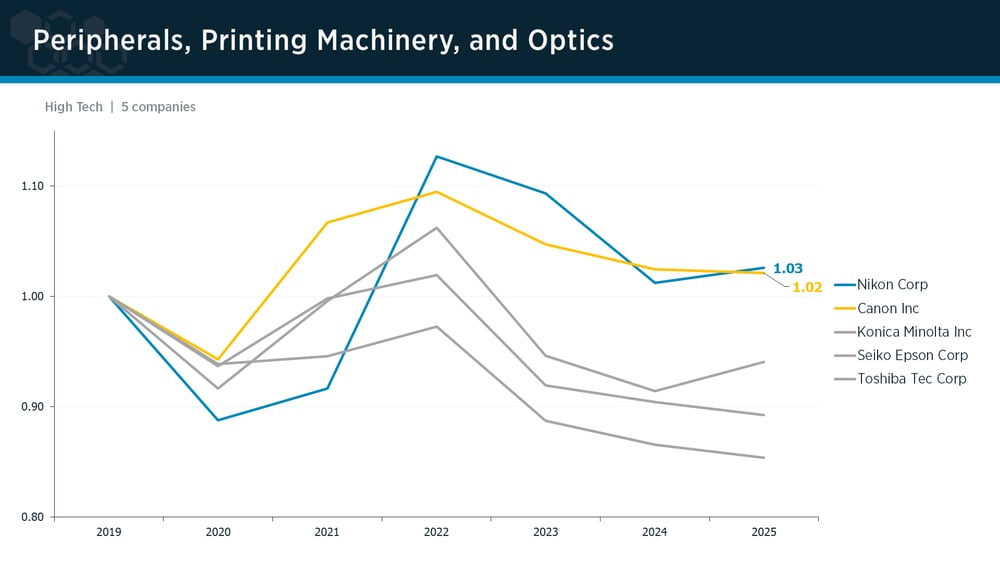
Despite the long-term nature of this market and these businesses, the High Tech Imaging peer group exhibited a similar productivity trend to many other industries: a surge in productivity from 2020 to 2022, followed by a decline in productivity in 2023 and 2024.
- Productivity in the sector increased by 15.4% over the last six years. This Peer Group performed above the average for manufacturers represented in the IPI and follows the general trend of a productivity bump in 2021 and 2022, followed by a return to stagnation and regression over the last two years.
- All these companies had negative productivity growth in 2024.
- In 2024, Productivity declined by an average of 5.5% across these companies.
- Canon earned its position within the LNS 2025 World’s Most Productive Companies by growing productivity 55.9% more than the average of its peers/competitors over the last six years. Canon’s leading productivity performance is driven by investments in automation, the development of in-house manufacturing capabilities, simplification of the manufacturing organization's structure, and investments in human capital development.