ENERGY

Oil and Gas Vertically Integrated

World's Most Productive Companies

Integrated Utilities: Balancing Legacy Energy and the Low-Carbon Shift

This group comprises regulated electric and gas utility companies that operate across the entire value chain (upstream, midstream, and downstream), managing the generation, transmission, and distribution of energy to residential, commercial, and industrial customers. These companies operate generation assets, such as combined-cycle plants, hydroelectric dams, and solar farms, and maintain transmission and distribution (T&D) infrastructure, including substations, transmission lines, transformers, and smart grid systems, often with global footprints, overseen by regional grid operators and public utility commissions. Companies face the strategic challenge of balancing their legacy fossil fuel businesses with investments in new energy sources (such as renewables, biofuels, etc.) as the world’s energy mix slowly shifts. Shareholders and governments are expecting companies to address climate change, leading to decarbonization pledges, portfolio adjustments, and cost-cutting measures to maintain dividend payments.
 
Oil price volatility from 2019 to 2024 required companies to aggressively cut capital spending and operating costs (workforce reductions) to endure the 2020 collapse. While upstream oil & gas remain core, the 2021–2022 rebound saw investments in low-carbon ventures. By 2023–2024, many companies will likely split off their renewables divisions or merge other businesses to improve focus and productivity.
 
Energy Oil and Gas Vertically Integrated

Top 100 World's Most Productive Companies - Oil and Gas Vertically Integrated

Chevron_Logo.svg
Petrobras

Productivity Snapshot

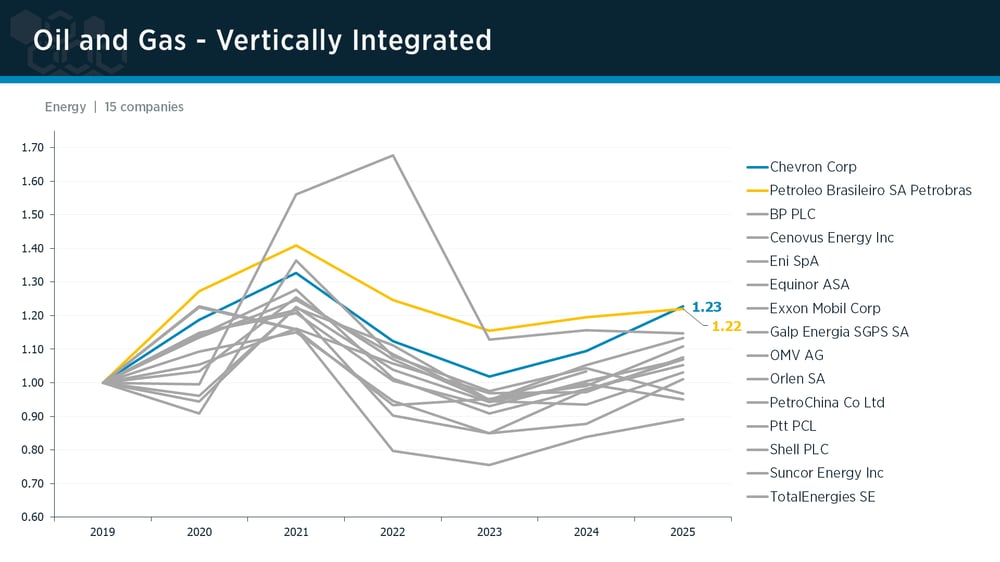
Similar to others in the Energy industry, the surge of productivity from 2020 to 2022 quickly rebounded into declining productivity in 2023 before seeing a modest gain in 2024.
  • Over the last twenty years, the group’s productivity declined by 67.9%, underscoring the significant structural erosion in productivity of big oil companies over the past two decades. The post-COVID rebound saw productivity growth increase by 42.7% from 2020 to 2022.

  • From 2022 to 2024, companies saw an average decline in productivity of 42.7%.

  • Thirteen of the 16 companies experienced positive productivity growth in 2023 and 2024.

  • Petrobras earned its position within the LNS 2025 World’s Most Productive Companies (WMPCs) by growing productivity 3.4% over the last six years, while others saw a double-digit decline. The company was able to dramatically outperform its peers with a focused strategy that included divesting non-core and downstream assets, while transforming its operations by adopting advanced technologies and implementing disciplined project execution.

  • Chevron Corporation also earned a spot in the 2025 WMPCs by “only” seeing a 4.6% decline in productivity between 2019 and 2024, a markedly smaller drop compared to industry peers. A “digitally enabled” operating model and disciplined capital strategy allowed it to set itself apart in productivity performance as transformation initiatives focused on analytics and automation in drilling and production operations helped maintain high efficiency in its U.S. shale assets and offshore platforms.
WMPC_Energy
Energy-2