CHEMICALS

Life Sciences and Sustainability

World's Most Productive Companies

Life Sciences: Growth Opportunities in a Sustainability-Driven Market

The Life Sciences & Sustainability peer group comprises companies that produce agricultural chemicals, including seeds and crop protection products (beyond basic fertilizers), enzymes, biotech materials, and water treatment chemicals. These firms often innovate in green chemistry, bioproducts, or serve industries like food and beverage, pharmaceuticals, and environmental management. The last six years saw relatively resilient demand, as 2019 trade disputes, low crop prices, and fluctuations in agricultural science challenged companies. However, tailwinds followed, driven by COVID-19, which spiked health-related sanitization demand, and new seed trait launches emerged due to global food security concerns.
 
 
The operating environment for this group is shaped by the push for sustainable solutions, including biodegradable materials, bio-based inputs, and water reuse. Meanwhile, consumer-driven demand for solutions that improve efficiency or reduce environmental impact is increasingly providing sustainability-focused segments with new opportunities.
With companies facing tightening agrochemicals and water quality safety and environmental regulations, water treatment chemical suppliers see water quality and reuse investments creating steady growth. Ecolab and Corteva’s service integration and digital transformation efforts have demonstrated how combining sustainability and operational intelligence drives measurable productivity growth.  


Chem Life Sci & Sustainability

Top 100 World's Most Productive Companies - Life Sciences and Sustainability

Corteva_logo.svg
Ecolab

Productivity Snapshot

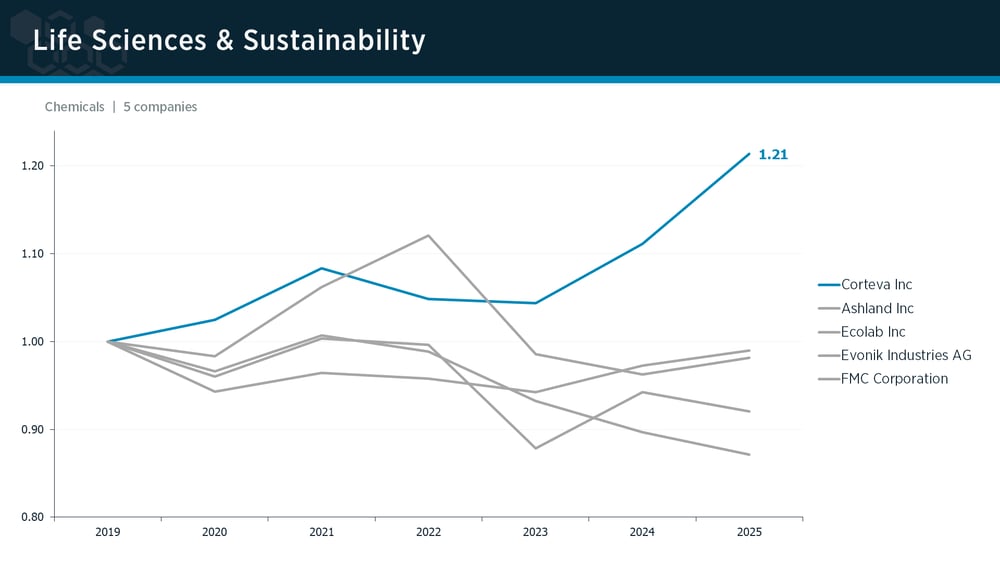
These companies saw COVID-era gains prove more durable for this peer group compared to industry peers.  
  • Productivity in the sector increased by 6.8% over the last six years. Although 2024 brought softening in select agricultural and industrial end-uses, service-led models and resilient demand has tempered volatility.

  • Between 2020 and 2022, productivity growth reached 30.7%, driven by healthy pandemic-related demand in certain niches.

  • The group’s productivity dropped by 5.1% from 2022 to 2024.

  • Last year, this peer group achieved an average productivity growth of 3%.

  • Corteva earned its position within the LNS 2025 World’s Most Productive Companies by achieving 9.7% productivity growth over the last six years, as the Chemical Industry saw productivity decline by 1.6%. Since spinning off from DuPont, the company’s strategy has focused on a balanced portfolio of seeds and crop protection chemicals, with significant R&D investments in advanced biotechnology and precision agriculture solutions. By leveraging an operating model to streamline decision-making, Corteva has brought higher-value products to market faster while ramping up more productive plants to optimize its manufacturing footprint.

  • Ecolab also earned a position on the 2025 WMPC list by increasing productivity by 8.0% over the past six years. Their disciplined high-value service-and-solution model in water, hygiene, and infection prevention focused on deploying advanced analytics through digital monitoring tools and IoT in customer sites. The company’s “Ecolab Lean” program promotes continuous improvement for relentless efficiency and targets innovation while maintaining outcomes (lightweight chemistries requiring less handling), which has allowed the company to outperform peers.  
WMPC_Chemicals
Chemicals-2