CHEMICALS
Inorganic and Performance Materials
World's Most Productive Companies

Strategic Evolution in Inorganic Performance Materials
The Inorganic and Performance Materials peer group includes companies that make pigments, additives, catalysts, ceramics, electronic materials, and other inorganic compounds. These firms often supply into automotive, aerospace, construction, electronics, and other manufacturing value chains with materials that enhance product performance (specialized coatings, advanced ceramics, battery chemicals). These companies tend to operate in highly specialized niches, balancing the scale of bulk chemicals with advanced materials that demand precision and innovation. Over the past twenty years, companies have faced a complex and mixed environment. The 2019 automotive and electronics downturn, as well as the 2020 COVID-19 shock, reduced demand for certain catalysts, coatings, and specialty materials. The COVID stimulus and restocking surge advanced demand for advanced materials (semiconductor chemicals, battery materials) from 2021 to 2022, before productivity deteriorated, and companies continued to face a pattern of volatility.
These companies are highly influenced by global manufacturing cycles and environmental regulations. Some have adjusted by moving toward higher-value, less energy-intensive offerings as raw material and energy costs have increased. With many inorganic chemical processes involving hazardous substances or mining, R&D investments that continually develop higher-performance or more sustainable material solutions will be critical.

Top 100 World's Most Productive Companies - Inorganic and Performance Materials
Productivity Snapshot
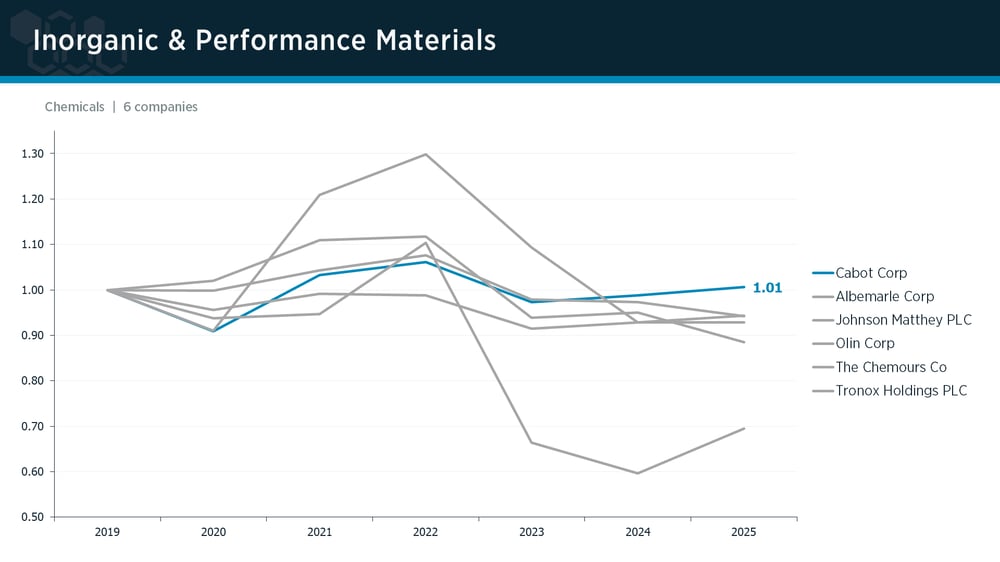
The Inorganic & Performance Materials group experienced short bursts of growth followed by consistent regressions.
- Overall productivity for this peer group declined by 1.1% over the last six years.
- The COVID-era boost enabled a 57.1% productivity growth from 2020 to 2022, higher than that of any other peer group in the Chemical industry.
- From 2022 to 2024, productivity declined notably by 24.4% due to labor constraints, higher costs, and the normalization of the supply chain.
- In 2024, five of the six companies experienced negative productivity growth, with the peer group averaging a 4.8% decline.
- Chemours Company earned its position within the LNS 2025 World’s Most Productive Companies by achieving a 9.8% productivity gain over the last six years, a stark contrast to the slight decline of the peer group. The company streamlined its portfolio by honing operations into high-margin niches (specialized refrigerants and pigments) and spun off DuPont for a more focused product mix (titanium technologies, fluoroproducts, and chemical solutions). As competitors struggled with legacy cost structures, Chemours modernized plants by digitizing operations, and disciplined process control minimized downtime and improved energy-to-output ratios in a volatile market.