CHEMICALS

Polymers and Petrochemicals

World's Most Productive Companies

Navigating Cycles in Polymers & Petrochemicals

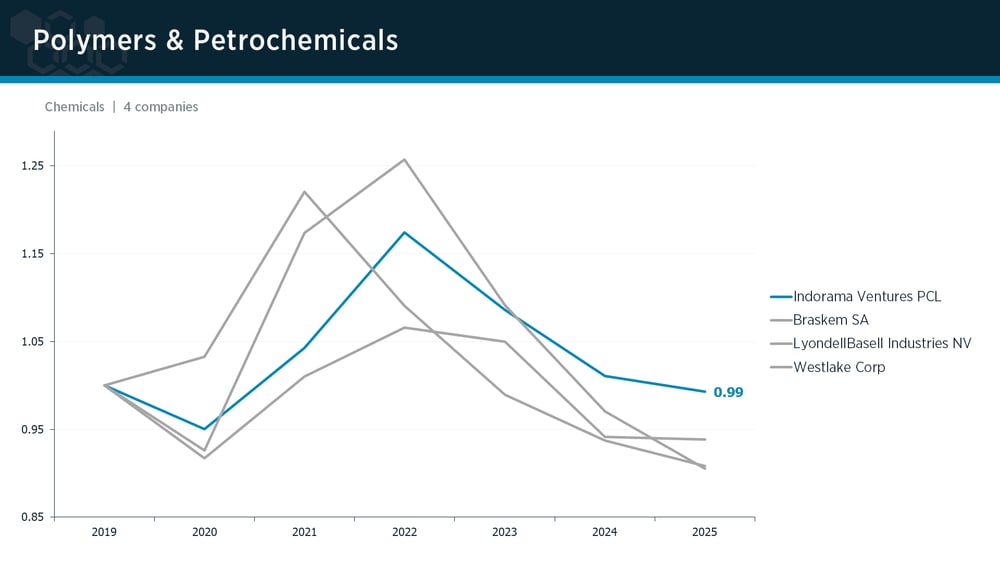
The Polymers and Petrochemicals peer group produces ethylene, propylene, polyolefins (including polyethylene and polypropylene), PVC, and other commodity resins for downstream customers that manufacture plastics, synthetic fibers, and chemicals. Companies often run large-scale operations (crackers, polymerization plants), which are highly cyclical and capital-intensive, being closely linked to feedstock economics (oil, natural gas) and global supply-demand balances. These companies observed distinct pandemic demand patterns and sharp fluctuations between 2019 and 2024, as new global capacity came online, leading to an oversupply in certain chemicals. The substantial surge in productivity from 2020 to 2022, driven by the pandemic era, was offset by a steep regression as demand patterns normalized and cost pressures returned. By 2022, geopolitical conflicts had created higher crude oil and natural gas prices, while the coming online of Asian mega-projects contributed to oversupply. These companies have remained cautious since 2023 as feedstock prices moderated, and demand growth cooled.
Long-term productivity challenges are attributed to longstanding efficiency challenges as global competition has increased. Factors influencing this group include the shale gas revolution (cheap ethane feedstock), capacity expansions in the Middle East and Asia, trade tensions (tariffs on polymers), as well as changing packaging, textiles, and shifting consumer preferences that end-use sectors face.
 
 
Chem Polymers & Petro

Top 100 World's Most Productive Companies - Polymers and Petrochemicals

Indorama Ventures
Westlake

Productivity Snapshot

Polymers & Petrochemicals have endured the steepest long-term productivity contraction of all peer groups.
  • Polymers and petrochemicals productivity remained relatively flat from 2019 to 2024, with a slight decline of 0.03%.

  • From 2020 to 2022, this group achieved an average productivity growth of 27.5%.

  • All of these companies had negative productivity growth from 2022 to 2024, with a 14.6% drop in productivity.

  • Last year, productivity declined by an average of 1% across these companies.

  • Westlake Corporation earned its position within the LNS 2025 World’s Most Productive Companies by delivering a 1.9% productivity improvement over the last six years, outperforming a peer group that was roughly flat. The company’s success comes from its integrated business model and a strategic focus on capturing efficiencies across the value chain. As both a major polyvinyl chloride (PVC) producer and a downstream building-products manufacturer, Westlake leveraged cheap U.S. shale gas feedstocks while keeping its resin plants running at high rates to feed its own product lines. The company also modernized its older ethylene units and maintained a conservative staffing approach, while peers expanded their workforces or incurred more downtime in response to market swings.
WMPC_Chemicals
Chemicals-2