CHEMICALS

Organic and Advanced Materials

World's Most Productive Companies

Advancing Performance in Organic & Advanced Materials

Companies in the Organic and Advanced Materials peer group produce high-performance plastics, synthetic rubbers, composites, advanced fibers, and other innovative materials that often replace traditional metal, glass, or natural materials due to superior properties (light weight, strength, heat resistance). Customers span automotive, aerospace, electronics, consumer goods, and industrial machinery sectors. The peer group experienced clear gains during the COVID era, driven by a premium mix and continuous improvement. However, this trend regressed from 2023 to 2024, as electronics and construction softened, while high inflation and interest rates dampened demand for plastics and composites.  Some companies pivoted to supply materials for medical devices and PPE to support growth spurts, as increased U.S.–China trade tensions and downturns in the automotive and aerospace sectors fueled setbacks.
 
The market environment for these players is dynamic, driven by trends such as lightweighting in transportation, miniaturization in electronics, and sustainability (including recyclable or bio-based polymers). Fluctuating petrochemical feedstock costs, the need to continually innovate new formulations, and competition both from large integrated chemical companies and specialized startups will continue to challenge profitability. Over the next years, R&D investments and more sustainable materials (recycled-content plastics, biodegradable polymers) are critical to productivity and overall profitability.
 
 
Chem Organic & Adv Mat

Top 100 World's Most Productive Companies - Organic and Advanced Materials

Eastman

Productivity Snapshot

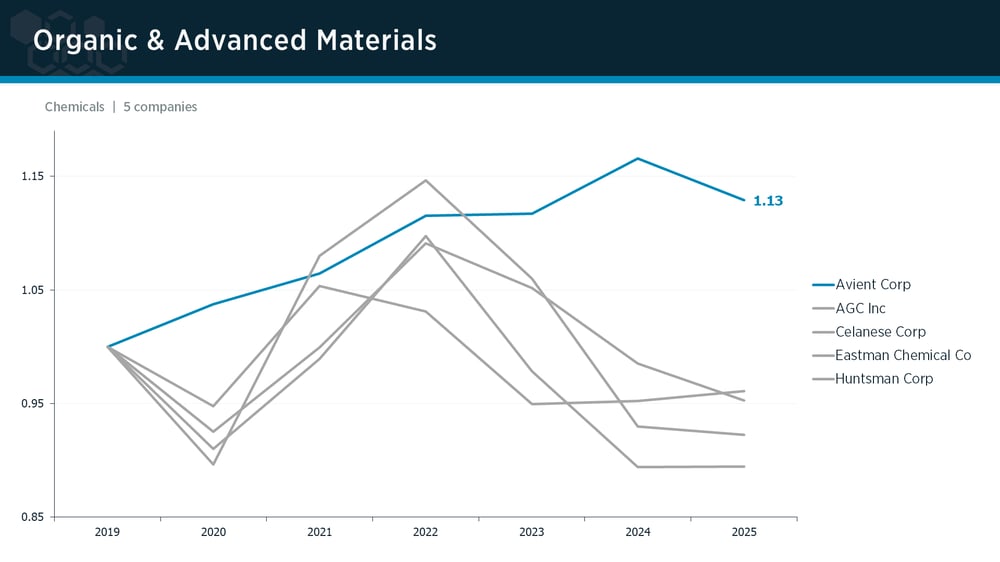
Organic and Advanced Materials producers saw similar volatility as many other industries and peer groups but outperformed long-term averages.  
  • Longer-term trends saw a notable 15.9% increase in productivity growth from 2004 to 2024.

  • Productivity for the sector grew overall by 5.1% over the last six years.

  • The segment experienced an impressive 42.1% productivity growth from 2020 to 2022, before productivity declined by 13% from 2022 to 2024.

  • Eighty % of these companies experienced negative productivity growth in 2023 and 2024, with productivity declining by an average of 2.9%.

  • Eastman Chemical Company earned its position in the LNS 2025 World’s Most Productive Companies by achieving a 9% productivity rise over six years, far exceeding the Chemical industry's 1.6% decline in productivity. The company made a strategic shift in its product portfolio towards specialty businesses and high-demand niches, including higher-value additives, advanced materials, and circular recycling technologies. Eastman has invested in advanced automation to modernize its operations and reduce labor-intensive steps through process simplification across its plants, achieving higher throughput and productivity growth.  
WMPC_Chemicals
Chemicals-2