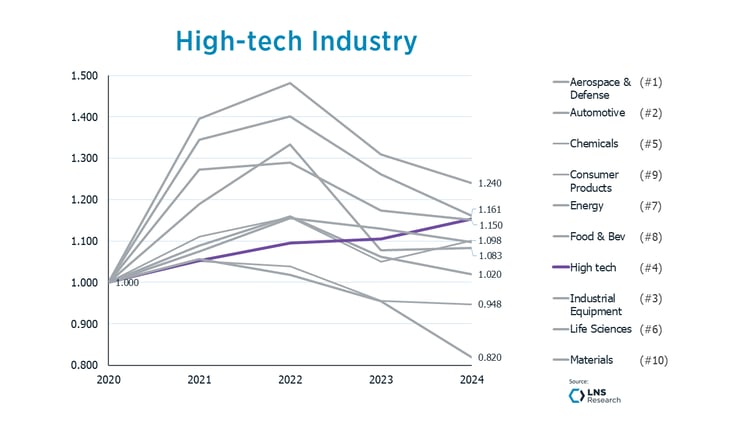
HIGH-TECH
Solar Products
World's Most Productive Companies
From PERC to n-Type: Productivity Divergence in Global Solar
Crystalline-silicon specialists compete on cost, efficiency, and scale. These firms operate along the solar photovoltaic value chain, with a focus on crystalline-silicon modules, often extending into cells, wafers, and, for some, upstream polysilicon production or downstream project development and services. All face China-centric supply chains, policy-driven access and pricing, and a rapid shift from PERC to n-type (TOPCon/HJT). Demand splits: strong utility-scale, rate-sensitive residential. Recorded overcapacity drove global module prices to approximately $0.10/W, compressing margins and elevating the importance of utilization, yields, and working capital.
Explosive installations, China-led manufacturing expansion, and policy tailwinds, especially the U.S. IRA, defined 2019–2024. Prices plunged after 2023 as overcapacity met easing logistics. Rapid adoption of n-type technology lifted efficiency and throughput. Yet interconnection, permitting, and higher interest rates constrained some demand, while rules like California’s NEM 3.0 reshaped residential economics and storage uptake.
In 2024, the companies in this peer group had dramatically different experiences. Line-level productivity rose where n-type conversions reached volume, as higher-efficiency modules increase sellable watts per hour with similar labor and footprint requirements. Where capital expenditures (capex) lagged or utilization fell due to price wars, measured productivity appeared flat, as idle time and defensive shutdowns offset the gains from process improvements. Price wars cut utilization, policy changes disrupted sourcing, and grid plus permitting bottlenecks caused stop-start execution. Residential shifts under NEM 3.0 and higher rates further dampened per-rep and per-installer productivity.
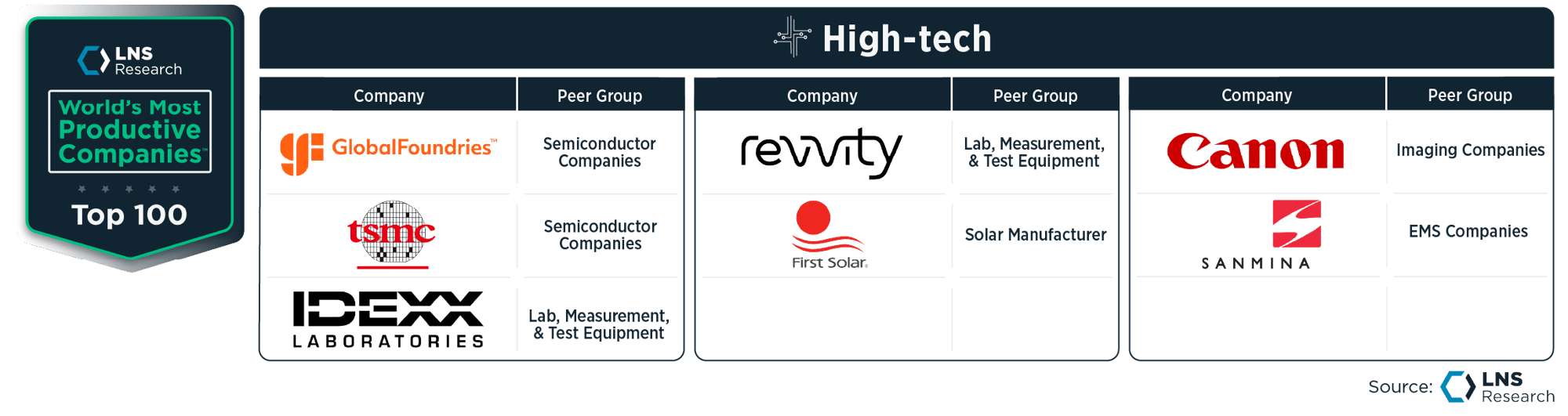
Top 100 World's Most Productive Companies - Solar Products

Productivity Snapshot
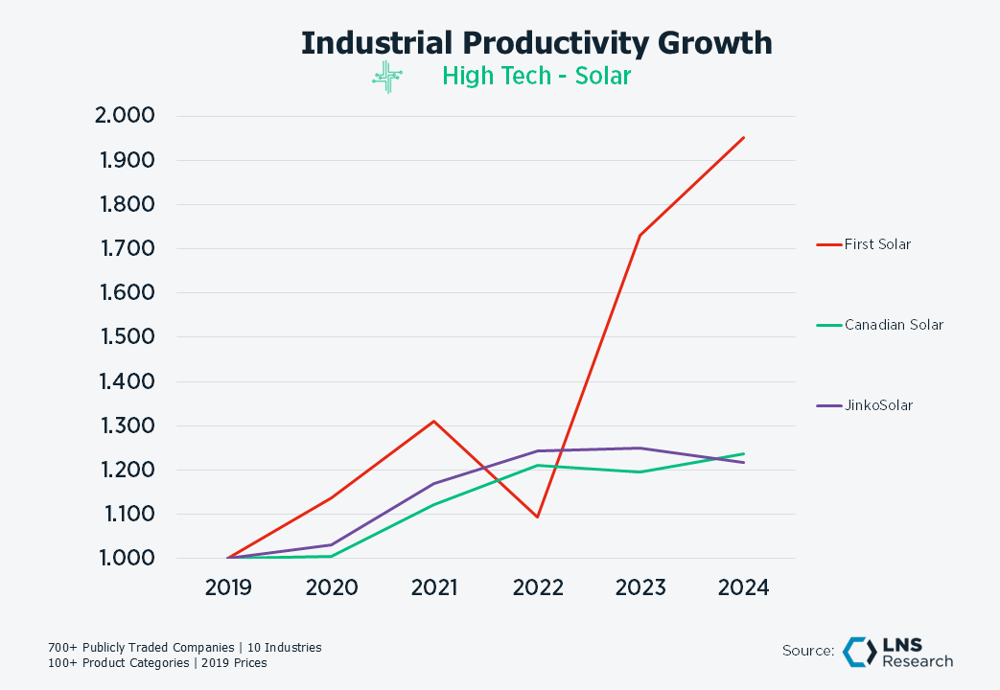
The Solar Peer Group has faced dramatic shifts over the past six years. The rise of China as a major player in the solar supply chain and as a competitor, as well as regulatory and policy shifts — both positive and negative — have caused significant fluctuations for the companies in this peer group.
- Productivity in the sector grew a respectable 31.6% over the last six years, largely driven by First Solar's performance. This Peer Group performed better than the overall average for manufacturers represented in the IPI. Excluding the performance of First Solar, the peer group performed only slightly better (4%) than the IPI average.
- Two of the three companies of this peer group had positive productivity growth in 2024.
- In 2024, Productivity fell by an average of 14.2% across these companies.
- First Solar is a two-time LNS Research Pathfinder company in this peer group. First Solar has improved its productivity over the six-year period by nearly 9.5 times the average of this peer group because it:
1) Operates a continuous, highly automated, vertically integrated process
2) Captured significant, documented gains in yield, utilization, and watts per module during and after the Series 6 transition
3) Accelerated learning and scale with Series 7 and U.S. expansions
4) Locked in steady loading through selective, long-dated contracting.
The firm’s explicit cost logic directly ties efficiency and throughput to the cost per watt, which, combined with policy-enabled reinvestment, created a multi-year productivity flywheel that peers using batch, multi-factory, polysilicon-dependent workflows struggled to match.